Dutch Elm Disease This Season: What to Watch For and Why Timing Matters

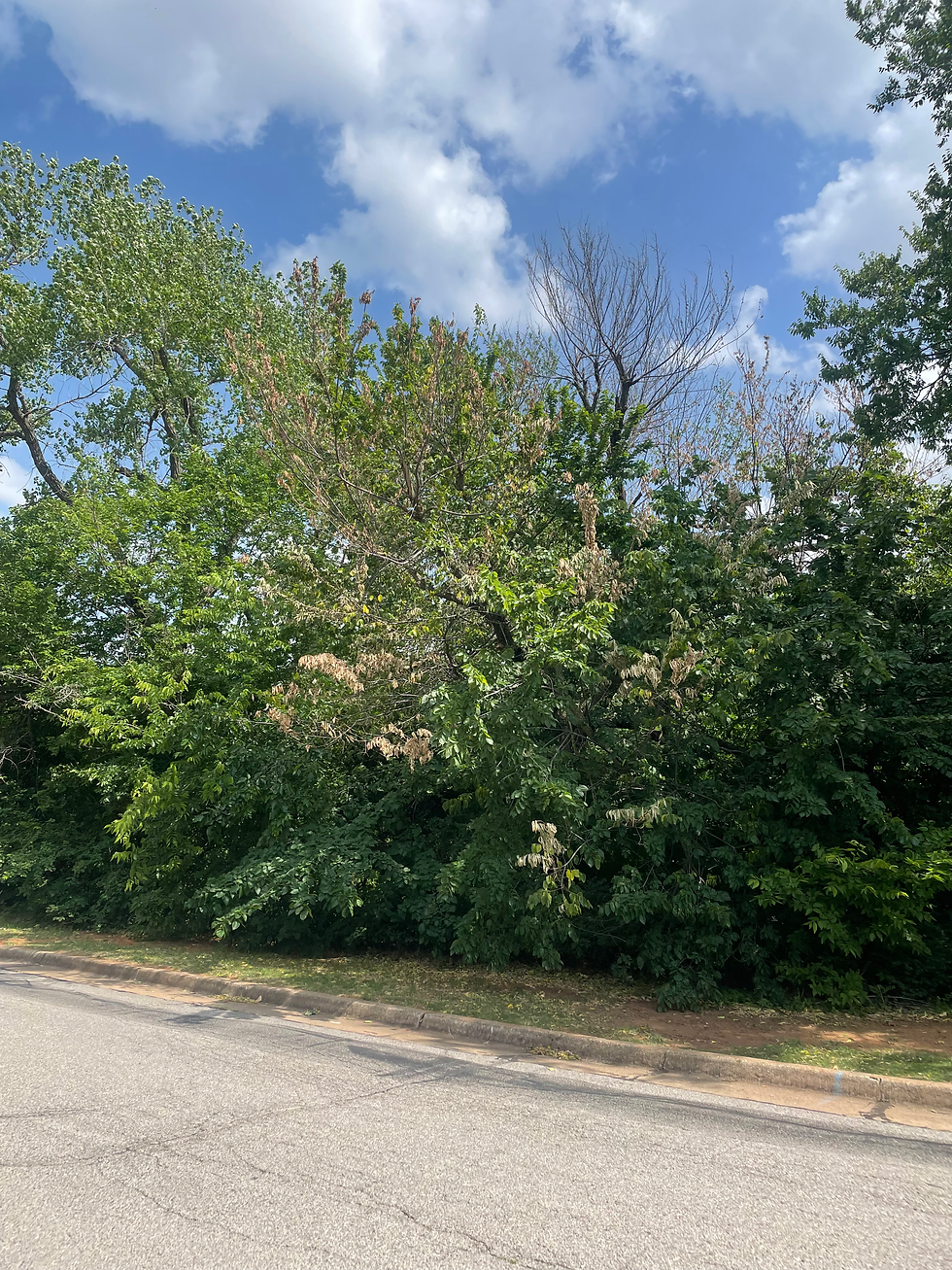
We're seeing high Dutch Elm disease pressure this year
If you have a mature American elm — or a Princeton, lacebark, or other elm of any age — this is the year to take a hard look at the canopy. We're seeing unusually heavy Dutch elm disease (DED) pressure across our service area, and the trees that get caught early are the ones that have a chance.
DED is a vascular fungal disease, today driven primarily by Ophiostoma novo-ulmi, a more aggressive strain of the fungus that took down most of North America's mature elms in the 20th century. It moves two ways: by elm bark beetles that pick up spores from infected wood and carry them to healthy trees while feeding in twig crotches, and through root grafts where elms have grown close enough that their root systems have fused underground. Either way, once the fungus is in the vascular system, the tree is on a clock that most of them lose.
What to look for
The classic first sign is flagging — a single branch, or a small cluster of branches, with wilted, yellowing, or browning leaves while the rest of the tree looks fine. It usually shows up in the upper crown first. The leaves often curl, turn yellow, then brown, and frequently stay attached rather than dropping cleanly.
If you peel back the bark on a small twig from a flagging branch, you'll see the diagnostic feature: brown to greenish-brown streaking in the outer sapwood, running with the grain. That's the fungus working its way down the vascular system. If you see it, call an arborist the same day. Don't wait until the weekend.
A few branches today is a tree-wide problem in six weeks. That's the speed of this disease.

Don't Forget about Squirrels
Squirrels gnaw on smooth-barked branches in the upper crown, and a girdled branch will wilt and die back in a way that, from the ground, looks a lot like DED flagging. We've also been called out for cicada damage, drought stress, and storm injury dressed up as flagging.
Here's how to tell the difference. Squirrel damage leaves visible chew marks and usually a clean girdle on a single branch, with random distribution around the tree and no progression over time. DED flagging starts at the branch tips and works backward, shows up in clusters, and — most importantly — has that vascular streaking under the bark. If you can reach a thumb-sized twig from a flagging branch and peel the bark with a pocket knife, that streak tells you everything you need to know.
If you can't get to it safely, call us. We'd rather rule it out than have you sit on it for two weeks because you assumed it was rodents.
Treatment is preventative, not reactive
This is the most important thing for elm owners to understand, and it's the part most people get backwards.
The fungicides that work against Dutch Elm Disease — primarily thiabendazole (sold as Arbotect 20-S) and propiconazole (sold as Alamo, Propizol, and others) — are macroinjected under pressure into the root flare, where they're carried through the vascular system up into the canopy. Used before infection, they create a chemical barrier that protects the tree, depending on the product and the rate, for roughly one growing season (propiconazole) up to about three seasons (thiabendazole).
Used after the tree is symptomatic, the same fungicides have a much harder job. They can sometimes help in combination with aggressive pruning if the disease is confined to a tiny portion of the canopy, but once the fungus is in the main stem or has crossed into an adjacent tree through root grafts, injection alone will not save the tree.
For high-value elms — anything mature, anything you care about, anything you'd be sick to lose — the right strategy is a preventive injection program on a rotating cycle, started before there are symptoms. We can talk through which product makes sense for your tree and how often it needs to be repeated.
The early-catch exception: bark tracing and therapeutic pruning

There is a narrow window, in theory, where a tree that's just starting to show symptoms can still be saved by cutting the disease out. The technique combines aggressive pruning of the affected branch system with bark tracing — following the brown vascular streak down the limb by lifting small V-shaped flaps of bark — to determine how far down the fungus has actually traveled.
The standard guidance is that the pruning cut needs to be made well below the lowest visible streaking, with at least roughly 10 feet of clear, unstreaked sapwood between the cut and the last streak, and ideally combined with a therapeutic fungicide injection of the kind that translocates quickly into the canopy.
The published numbers are sobering but not hopeless. Research has shown that roughly two out of three trees pruned at the first appearance of symptoms — with 5% or less of the crown affected — were saved. That success rate drops to about one in three when pruning is delayed by even one to four weeks. And the technique simply does not work if the fungus has already reached the main stem, or if it has moved into an adjacent elm through root grafts.
Translation: early-catch therapeutic pruning is a real option, but it only works if it happens fast, on the right tree, executed by someone who knows where to cut and how to read the streaking. It is not a DIY procedure, and it is not a substitute for a preventive program on the trees you actually care about.
What to do this week
Walk your property and look up. If you have any elms, scan them for flagging — a branch or cluster of branches with wilted leaves while the rest of the crown is healthy. If you see anything that looks suspicious, call us before you do anything else. Don't prune it yourself; the cut location and the disposal of the cut wood both matter, and infected wood left on the ground or in a brush pile is exactly how the local beetle population stays high.
If you have a mature elm that has never been on a preventive injection program, this is the year to start. The disease pressure is real, the treatment window is preventive, and the trees we save are the ones whose owners called us before there was anything to look at.
Concerned about an elm on your property? Contact Urban Tree Consultants to schedule an inspection.


Comments